
Thinking about buying a photography franchise but not sure whether you're actually ready? You're asking the right question, and asking it early saves lakhs.
Most people who enquire about a franchise are ready in one or two areas and completely unprepared in the rest. They have the capital but not the time. Or the passion but not the appetite for sales. Or the camera skills but no interest in running a team.
Readiness is not about how good your photography is. It is about whether your money, your calendar, your temperament, and your local market all line up at the same time.
Established brands such as G.K Vale Corporate look for exactly this combination when they evaluate franchise partners, because a well-matched owner protects both sides of the agreement.
This guide walks through the 7 clearest signs you're ready to own a photography franchise, the 3 red flags that mean you should wait, and a quick self-assessment you can score in two minutes.

What Does Being Ready for a Photography Franchise Actually Mean?
Being ready for a photography franchise means you have the liquid capital to fund setup plus 6–12 months of operations, the time to run the business full-time, the willingness to sell rather than only shoot, and a local market with enough weddings, corporate clients, or families to support a branded studio.
Readiness sits across four buckets: financial, operational, personal, and market. Weakness in any one of them tends to show up in month eight, not month one, which is exactly when it hurts most.
The good news is that every one of these is testable before you sign anything.
7 Signs You're Ready to Own a Photography Franchise
If most of the following describe you honestly, you're in strong shape to move forward.
1. You Have Liquid Capital, Not Just Assets on Paper
Property and gold on your balance sheet are not the same as cash in your account. Franchise setup runs from roughly ₹20 lakh to well over ₹1.5 crore depending on city and format, and the working capital line is the one people underestimate.
You're ready when you can fund the setup and hold 6–12 months of running costs without touching your household budget.
2. You're Comfortable Selling, Not Just Shooting
This is the single biggest predictor of franchise success, and the one most photographers resist.
An owner's week looks like this:
- Following up on enquiries within the hour
- Quoting wedding packages and negotiating
- Pitching corporate HR teams for headshot contracts
- Chasing repeat business from past clients
- Handling the occasional unhappy customer personally
If reading that list energises you, that's a green light. If it drains you, you may be better suited to being a photographer than a franchise owner.
3. You Can Commit Full-Time for at Least Two Years
Most photography franchises reach break-even somewhere between 18 and 36 months. That window demands an owner on the floor, not a silent investor checking a dashboard.
Ask yourself plainly: can you give this six days a week, including wedding-season weekends and festival peaks, for the next 24 months?
4. You Already Understand Your Local Market
Ready owners can answer these without Googling:
- How many weddings happen in their city each season
- Which localities have the highest household spend
- Which corporate parks and hospitals sit within a 10 km radius
- Who the three strongest local competitors are and what they charge
- Whether their city skews wedding-heavy, corporate-heavy, or portrait-heavy
If you can sketch that map from memory, you already have an advantage most applicants don't.
5. You're Willing to Follow Someone Else's System
A franchise is a rented system, not a blank canvas. You will be asked to follow set pricing bands, brand guidelines, editing standards, CRM processes, and customer service protocols.
Owners who treat the system as a shortcut thrive. Owners who quietly override it to "do it their way" lose the very consistency they paid for.
6. You Can Hire, Train, and Retain a Team
A functioning studio typically needs 4–8 people covering front desk, shooting, editing, and printing. Attrition among junior editors and shooters is a genuine industry challenge.
You're ready when you're comfortable interviewing, correcting underperformance, and paying slightly above market to keep good people.
7. You're Planning for a 10-Year Horizon, Not a Quick Exit
The real money in a photography franchise comes from repeat customers and referral chains built over years. A family who books a baby shoot with you often returns for birthdays, graduations, and eventually a wedding.
If you're thinking in decades rather than quarters, the economics work in your favour.

Quick Self-Assessment: Are You Photography Franchise Ready?
Score one point for every honest yes. This mirrors the kind of screening most established franchisors run during discovery.
| # | Readiness Check | Yes / No |
|---|---|---|
| 1 | I have setup capital plus 6–12 months of operating funds in liquid form | |
| 2 | I enjoy selling and following up with customers | |
| 3 | I can work full-time on this for 24 months | |
| 4 | I can describe my local market's demand without research | |
| 5 | I am comfortable following a franchisor's system | |
| 6 | I have hired and managed staff before | |
| 7 | I am planning to hold this business for 10 years or more |
How to read your score
- 6–7 yes: You're franchise-ready. Start discovery conversations now.
- 4–5 yes: Close. Fix the gaps first, especially if capital or time is the gap.
- 3 or fewer: Wait. Build the missing piece before you commit capital.
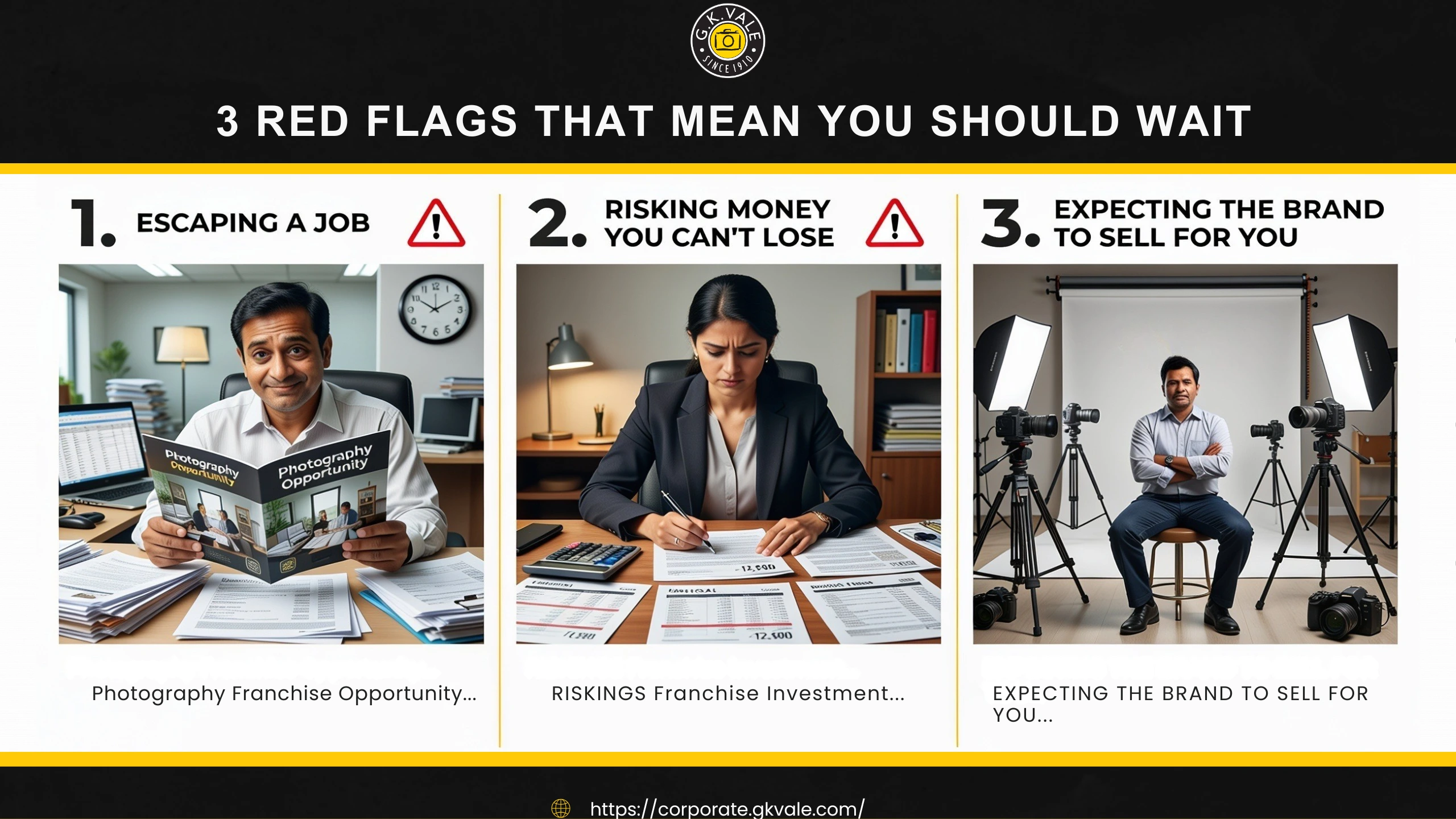
3 Red Flags That Mean You Should Wait
These three signals show up repeatedly in franchise agreements that end badly.
1. You're Buying Mainly to Escape a Job You Dislike
Wanting out of a job is a reason to change jobs. It is not a business plan.
Owners driven purely by escape tend to lose momentum around month nine, when the novelty has worn off and the work has become genuinely hard. Buy a photography franchise because you want this business, not because you want to leave something else.
2. You're Funding It With Money You Cannot Afford to Lose
Retirement savings, a mortgaged family home, or borrowings from relatives create a pressure that distorts decision-making. Under that pressure, owners discount aggressively, skip marketing spend, and cut staff costs at exactly the wrong moment.
Fund a franchise with risk capital, not survival capital.
3. You Expect the Brand Name to Do the Selling for You
A strong brand shortens the customer's decision. It does not replace your outreach.
Even a legacy name like G.K Vale works best when the local owner is actively building relationships with wedding planners, corporate HR teams, schools, and hospitals in their territory. Brand equity opens the door. You still have to walk through it.
Ready vs Not Ready: A Side-by-Side View
| Factor | Franchise-Ready Owner | Not Ready Yet |
|---|---|---|
| Capital | Setup cost + 6–12 months buffer, liquid | Setup cost only, or borrowed from savings |
| Time | Full-time, 24-month commitment | Part-time or "I'll hire a manager" |
| Motivation | Wants to build this specific business | Wants to exit current job |
| Sales attitude | Enjoys pitching and following up | Prefers to stay behind the camera |
| System | Happy to follow proven SOPs | Plans to customise from day one |
| Market knowledge | Knows local demand and competitors | Assumes demand exists |
| Horizon | 10+ years | 2–3 years, then resale |
Common Mistakes First-Time Photography Franchise Owners Make
Even ready owners trip on these. Knowing them in advance is half the fix.
- Underbudgeting working capital. Setup gets funded generously; month-seven salaries don't.
- Opening just after wedding season ends. Launch ahead of the peak, not after it.
- Hiring only shooters. Editing and front-desk quality drive reviews just as much.
- Ignoring the corporate segment. Headshots, product shoots, and events smooth out seasonal dips.
- Skipping local marketing because national brand campaigns are already running.
- Not speaking to existing franchisees before signing. Always ask for three contacts.
Key Takeaways
- Readiness is financial, operational, personal, and market-based — not creative
- Budget setup cost plus 6–12 months of working capital
- Break-even typically lands at 18–36 months
- Sales appetite predicts success more than photography skill
- Score 6–7 on the checklist before starting discovery conversations
- Three red flags: escape motivation, survival capital, passive brand reliance
Take the First Step Towards Owning a Photography Franchise
Deciding whether you're ready to own a photography franchise comes down to an honest audit rather than a gut feeling. The seven signs above cover capital, time, sales appetite, market knowledge, system discipline, team management, and long-term horizon. Score six or seven and you're in a genuinely strong position to move forward.
The three red flags matter just as much. Buying to escape a job, funding with money you cannot afford to lose, or expecting a brand name to sell on your behalf are the patterns that most often precede a struggling first year.
If you scored well, your next steps are straightforward: shortlist two or three brands, ask for full financial disclosures, speak directly with existing franchise partners, and pressure-test the numbers against your own city rather than a national average. Legacy brands such as G.K Vale Corporate show how consistency, training, and operational depth translate into durable franchise performance over decades.
If you scored lower, that is useful information, not a rejection. Fix the single weakest bucket first, then revisit this checklist in six months.
Exploring photography business opportunities? Follow G.K Vale Corporate on Instagram for franchise updates, owner stories, and industry insights.